The Madwoman
Don’t zoom in too close.
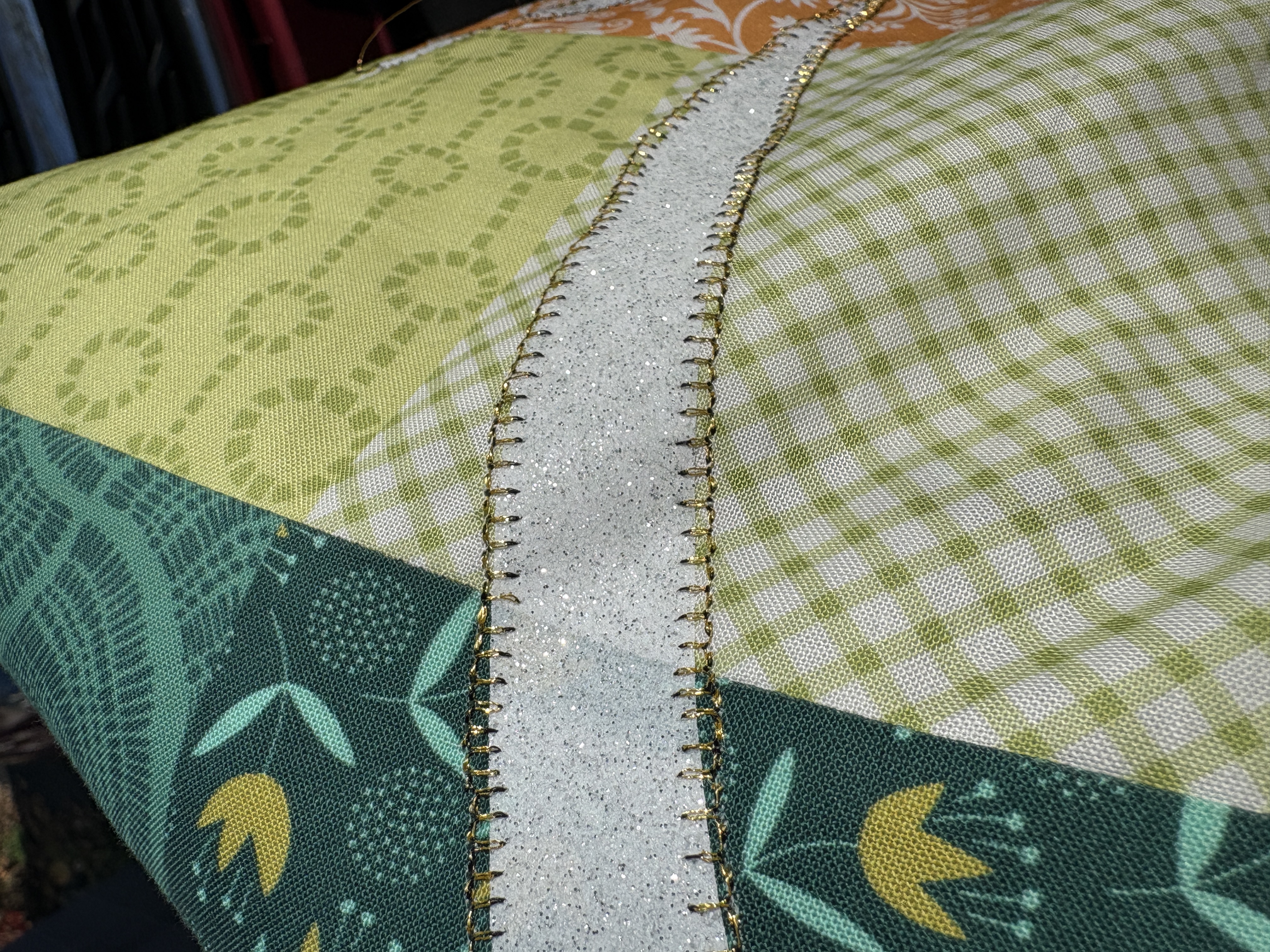
That was my first thought when I considered showing someone the stitching on the quilt I’ve been making. Because there are mistakes. Quite a few of them, actually. Places where the stitches aren’t quite the same width, where the fabric puckered slightly, where a curve didn’t turn as gracefully as I’d intended, or the thread wandered just far enough from the edge to make me wince. I can see every single one, and my immediate instinct was to warn people not to look too closely.
But the longer I sat with that thought, the more ridiculous it became.
Actually, fuck it. Zoom all the way in.
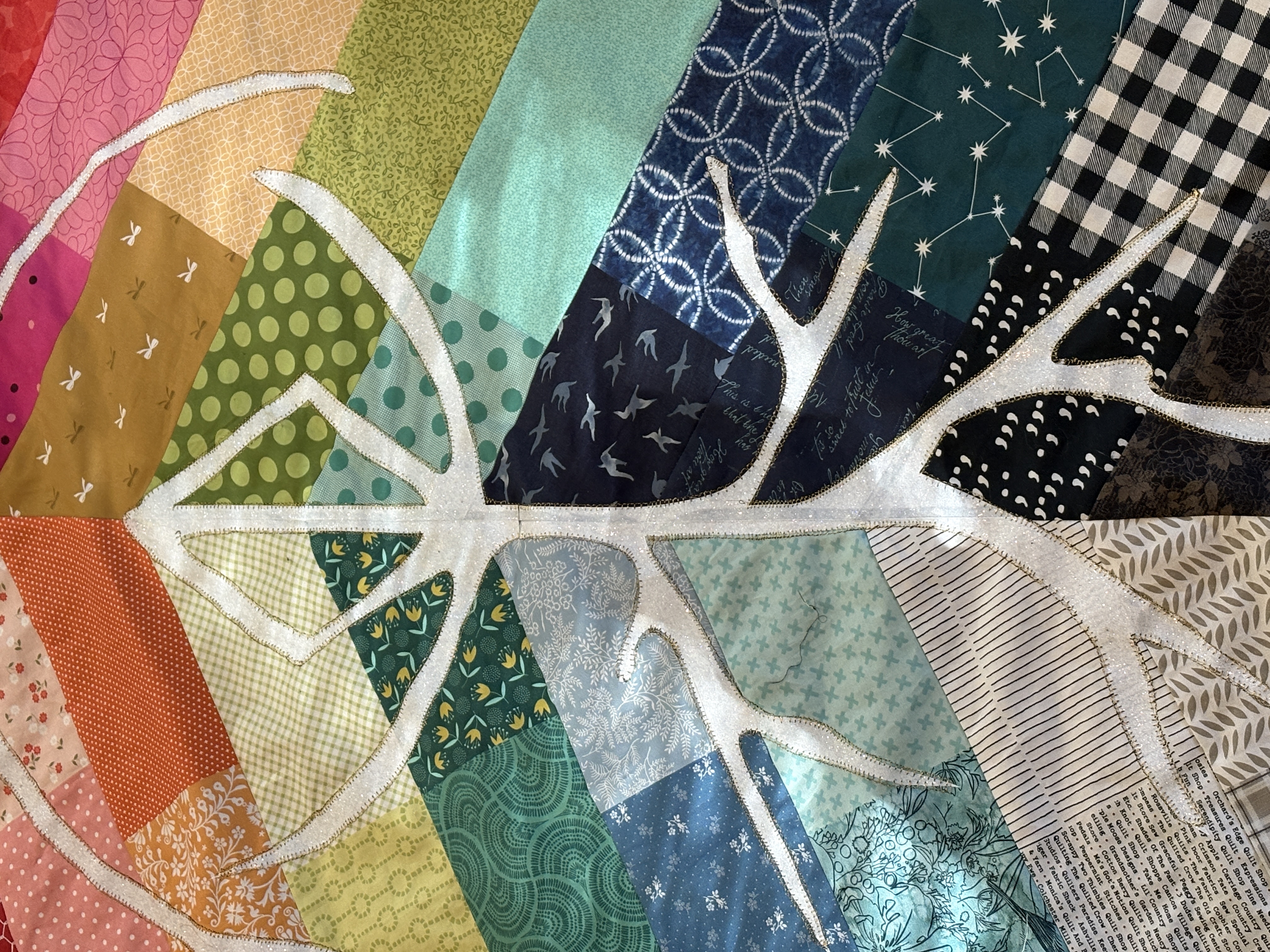
I’ve been working on an appliqué for the quilt. A rather intricate symbol, cut from white glittering vinyl and stitched over an arrangement of cotton fabrics. The design has roots that twist and turn, narrow passages, sweeping curves, and several places where the shape becomes particularly difficult to navigate. Naturally, I decided this would be an excellent opportunity to use a stitch that doesn’t particularly enjoy tight corners. Because apparently I require my hobbies to present a reasonable risk of emotional damage.
But the difficulty wasn’t simply the shape. It was the material.
Vinyl is not especially forgiving when you put a needle through it. Cotton will generally tolerate being sewn, unpicked, and sewn again. Vinyl remembers. Every puncture remains. If I placed a stitch incorrectly, I couldn’t simply remove the thread and pretend it hadn’t happened. The holes would still be there, visible evidence of whatever decision I’d made. And if I tried to correct too much, I risked damaging the material beyond what I was willing to accept.
So I had to approach the stitching differently. There would be no endless starting over. I needed to make decisions, commit to them, and keep going.
The actual sewing was far more demanding than I’d anticipated. The vinyl was white and covered in glitter. Beneath it were fabrics in varying shades and patterns, some of them light enough that the edges of the appliqué became difficult to distinguish. I spent a ridiculous amount of time staring at this glittering surface, trying to determine exactly where one material ended and another began.
There were moments when I could see the path clearly and moments when I couldn’t. Moments when I had to make a decision almost immediately, knowing that a wrong turn could visibly alter the image I was trying to create. I found myself almost hypnotized by it, watching the edge, listening to the machine, and trying to keep my hands steady while the needle continued making tiny, permanent decisions.
And I did all of it in silence.
No music. No podcast. Nothing playing in the background. Just the sound of the machine and my own thoughts. For someone who generally has music woven into nearly everything she does, that was a rather deliberate choice. I wanted to hear what I was doing. I wanted to pay attention to the rhythm of the machine, the movement of the fabric, and the changes in resistance as I worked. And perhaps, for once, I wanted to hear myself think without asking something else to accompany me.
It wasn’t particularly relaxing. It was intense, occasionally frustrating, and visually exhausting. But I stayed with it.
There was another decision I kept having to make: the speed.
I kept the machine on its medium setting. Now, anyone who knows me knows that I am not exactly famous for my patience. I like movement, progress, and results. If something can be done efficiently, I generally want to know why the hell we’re still discussing it. And there were plenty of moments when I wanted to turn the speed up.
I knew I could. The machine could certainly handle it. But the stitching required consistency, and increasing the speed would have made those difficult turns harder to control. A moment of impatience could have created a much more noticeable disruption than the imperfections I was already learning to accept.
So I kept it slow. Every time I wanted to accelerate, I made myself reconsider. Not because I was afraid of finishing, but because I understood what rushing might cost me.
Just because I could go faster didn’t mean I should.
It’s a stupidly simple concept. One I apparently needed to learn while staring directly into a glitter-covered piece of vinyl for an unreasonable amount of time.
Somewhere in all of this, something shifted.
At first, every imperfect stitch bothered me. I’d notice a slight change in width or an uneven turn and immediately consider whether I should remove it. Could I fix that? Would it look better if I started again? Was I going to regret leaving it?
But as I continued, I became less interested in undoing what I’d already done. Not because I stopped caring. I cared enormously. I knew exactly how much attention, effort, and judgment went into every section. I understood the materials, what could be corrected, and what could be damaged by trying. And eventually, I began recognizing that attempting to erase every mistake might do more harm than simply allowing it to remain.
I wasn’t lowering my standards. I was learning to distinguish between something imperfect and something that actually needed fixing.
That mattered because perfection had begun to demand things of me that the work itself didn’t require. More time, more damage, more uncertainty, and more opportunities to make something worse while trying desperately to make it flawless. And I didn’t want to do that anymore.
I’ve spent the majority of my life examining things very closely. My decisions, my relationships, my work, my mistakes. I can revisit a conversation until I’ve practically worn the words smooth, searching for the moment I should have said something differently. I can recognize patterns, anticipate consequences, and construct several possible outcomes before anyone else has finished explaining the problem.
That ability has served me well, but it can also become exhausting. Because somewhere along the way, paying attention can turn into believing that if I examine something closely enough, I should be able to prevent every possible mistake. And if something goes wrong anyway, clearly I should have looked harder, thought longer, or been more careful.
Except that’s not how making things works. And it’s certainly not how living works.
Sometimes you’re working with materials that won’t forgive you. Sometimes the edge you’re trying to follow becomes difficult to see. Sometimes you make the best decision available with the information you have, and the result is still a little crooked. You can acknowledge that without deciding the entire thing is ruined.
There’s a difference between letting my brain rest and abandoning my judgment. I was still thinking while I worked. Constantly, in fact. But I wasn’t stopping to interrogate every choice once it had already been made.
My hands knew things my thoughts didn’t need to explain. I knew how to adjust the fabric, how to respond to the sound of the machine, and how to recognize when a turn required more attention. And when a stitch went somewhere I hadn’t intended, I assessed it and moved on.
I allowed myself to trust what I knew without demanding that every decision produce perfect evidence of my competence. Which is a rather significant development for someone who has spent much of her life believing that being capable means being able to prevent things from going wrong.
Sometimes being capable means knowing what to do when they do. Sometimes it means recognizing that you can continue. And sometimes it means having the discipline to keep the machine on medium speed when every impatient part of you wants to floor it.
I’m not finished with the quilt. There’s still plenty more work to do, more decisions to make, and undoubtedly several opportunities for me to stare at something I’ve sewn and mutter an impressive collection of obscenities.
But I already know something about how I intend to present it.
I don’t want to hide the stitching. I don’t want to photograph it from a distance where the imperfections disappear. I don’t want to apologize for the places where the thread wandered, the fabric puckered, or the curves required more negotiation than grace.
Because I know what happened there. I know what I was working with. I know what decisions I made and why I made them. I know which materials couldn’t be punctured again, and why I chose to use them anyway. And I know how many times I resisted the urge to rush something simply because I wanted to be finished.
There are mistakes in that stitching. They’re visible, they’re permanent, and they’re part of something I am genuinely proud to have made.
I think I want to offer the quilt to the world the same way I’m learning to offer myself. Not flawless, and not particularly interested in pretending otherwise. Still a little ridiculous. Still entirely too fond of things that sparkle. But willing to be examined without first attempting to conceal every place where something didn’t go according to plan.
Because I don’t need anyone to mistake my work for perfection to understand that I put my heart into it. And perhaps more importantly, I don’t need perfection to recognize my own effort anymore.
So go ahead. Zoom in. Look at the uneven stitches, the awkward turns, the places where the line wandered and I decided to keep going.
I can see them, too.
I was there when they happened. And I know exactly what it took to keep sewing.